Engineering Lesson
180 minutes (4 45-minute classes)
Lesson Time:
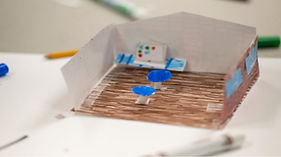
The purpose of Lesson 12 is a summative assessment for the unit to synthesize ideas across building designs to design and build a green learning space. Students design a final learning space using all the energy and energy transfer ideas from the unit to achieve a design that is both energy-efficient and within the project constraints.
What will we do?
Review the ideas we’ve developed in the unit using our Design Notebooks.
Work towards a consensus design, test it using a digital simulation, and then iterate on the design to make improvements.
Communicate with others about our design.
Materials needed
Per student | Per Group | Per Class |
|---|---|---|
|
|
|
Advance preparation
Preview slides and teacher guide.
Order or gather cardstock or other material for house build
Gather scissors, tape, markers, crayons, and/or colored pencils
Print handouts.
Copyright © 2026 The Curators of the University of Missouri in collaboration with Colorado State University, BSCS Science Learning, and Oregon Public Broadcasting.
This material is based upon work supported by the National Science Foundation (Award No 2201204). Any opinions, findings, and conclusions or recommendations expressed in this publication are those of the author(s) and do not necessarily reflect the views of the NSF.