Anchoring Phenomenon Lesson
135 minutes (3 45-minute classes)
Lesson Time:
The purpose of Lesson 1 is for students to have a shared experience of a phenomenon together and to begin to generate initial ideas and questions about the phenomenon. In this unit, the phenomenon is “green schools” or schools that have been designed to reduce energy use and environmental impact. The initial ideas and questions students have about these schools will serve as the basis for investigations throughout the unit.
What will we do?
Explore pictures and case studies of green schools.
Compare our school to the green school case studies.
Generate a list of related phenomena.
Develop a list of initial design ideas for a green school.
Generate our questions for a Driving Question Board and ideas we have for investigation.
Materials needed
Per student | Per Group | Per Class |
|---|---|---|
|
|
|
Advance preparation
Plan for a building walk.
Preview slides and teacher guide.
Print handout.
Decide how to group students for the green school case studies readings on Day 1.
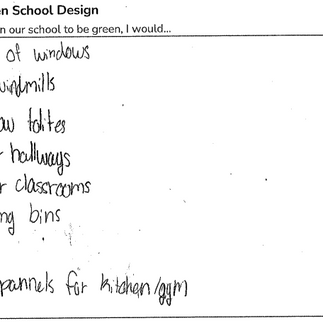
Lesson student work examples




Lesson chart examples





Copyright © 2026 The Curators of the University of Missouri in collaboration with Colorado State University, BSCS Science Learning, and Oregon Public Broadcasting.
This material is based upon work supported by the National Science Foundation (Award No 2201204). Any opinions, findings, and conclusions or recommendations expressed in this publication are those of the author(s) and do not necessarily reflect the views of the NSF.